Introducing The 6 I's of Horsemanship - because it all starts with you
The 6 I's of Horsemanship
Because it all starts with you
The 6 I's of Horsemanship
Because It All Starts With You
If there's one thing horses have taught me, it's that they don't really care how much we know.
They care how we show up.
They don't know how many books we've read.
They don't know which clinician we follow.
They don't care how expensive our tack is or how many ribbons hang on the wall.
They simply respond to the person standing in front of them.
For years, I thought becoming a better horsewoman meant collecting more knowledge.
Learning another technique.
Watching another clinic.
Reading another book.
And while those things certainly have their place, over time I realised something much more important.
The biggest breakthroughs rarely came from discovering a new exercise.
They came from changing the way I thought.
Instead of reacting, I started becoming curious.
Instead of asking, "How do I fix this?"
I started asking,
"What is actually happening?"
"Why might it be happening?"
"What matters most here?"
"What am I actually trying to achieve?"
"What's the best next step?"
"What can I learn from this?"
Those questions became the foundation of something I've been developing for many years.
I call it The 6 I's of Horsemanship.
Not another training method.
It's a way of thinking.
The Problem Isn't a Lack of Information
One of the biggest challenges horse owners face today isn't a lack of information.
It's the overwhelming amount of it.
Open social media and you'll find hundreds of opinions about almost every aspect of horsemanship.
One trainer tells you to be firmer.
Another tells you to soften.
One believes in liberty.
Another in traditional horsemanship.
Another in dressage.
Another in positive reinforcement.
Each produces wonderful horses.
Each has something valuable to teach.
Yet they often arrive there in very different ways.
For someone just beginning their journey, that can feel incredibly confusing.
It's easy to start questioning yourself.
It's easy to jump from one method to another.
It's easy to spend more time chasing opinions than listening to your own horse or yourself.
I don't believe the answer is finding the perfect clinician.
I believe the answer is developing a way of thinking that helps you thoughtfully decide what belongs in your own horsemanship toolbox.
Your Horsemanship Is Yours to Create
One of the most liberating things I've learned is this:
There is no perfect horsemanship program waiting to be discovered.
There is only the one you intentionally build.
Every horse you meet...
Every book you read...
Every clinic you attend...
Every conversation you have...
Every mistake you make...
Every success you celebrate...
Adds another piece to your understanding.
You don't have to agree with everything someone teaches.
You don't have to choose one style of horsemanship and defend it for the rest of your life.
You simply take what aligns with your values, your horse and your goals, and leave the rest.
Over time, you begin creating a horsemanship philosophy that is uniquely your own.
One that continues to evolve as you do.
The 6 I's: A Framework for Thinking
This is where the 6 I's comes in.
The 6 I's isn't designed to tell you exactly what to do.
It won't replace experience.
It won't replace good mentors.
It won't replace learning.
Instead, it gives you a framework for making sense of it all.
Every challenge.
Every piece of advice.
Every clinician.
Every breakthrough.
Every setback.
Can be thoughtfully worked through using the same six questions.
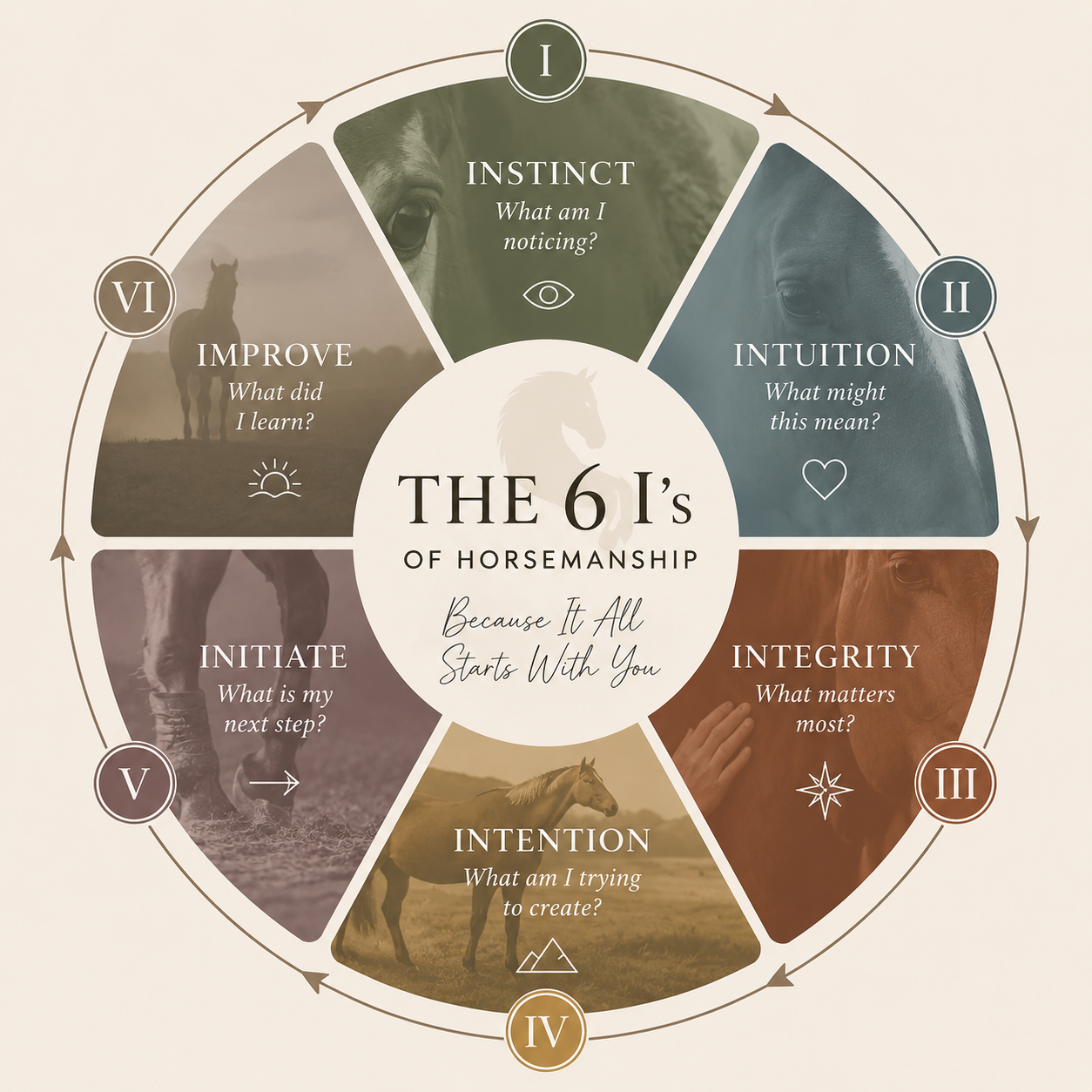
Instinct
What is happening?
Intuition
What does it mean?
Integrity
What matters?
Intention
What am I trying to achieve?
Initiate
What am I going to do?
Improve
What did I learn?
Rather than reacting emotionally or following advice blindly, the framework encourages you to slow down, observe carefully and make intentional decisions.
Over time, it becomes less about solving today's problem and more about becoming the kind of horseperson who can confidently think through tomorrow's challenges.